
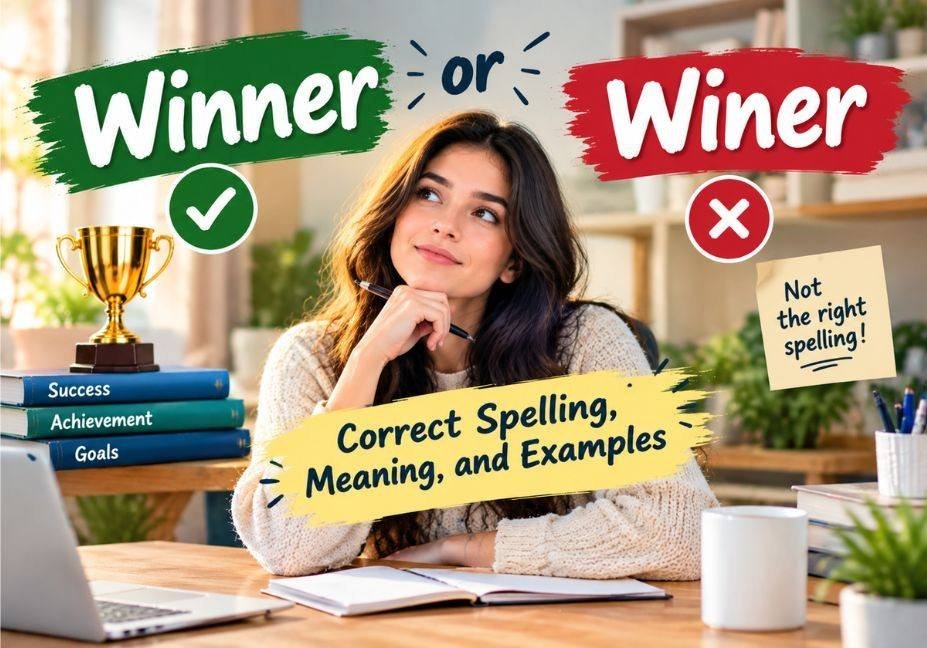
Have you ever typed winner or winer and paused because both versions looked possible? You are not alone. Since the word win has only one n, adding another n can seem strange at first.
This guide gives you the correct spelling, meaning, grammar rule, and pronunciation. You will also see natural examples and learn whether winer can ever be a real word.
Winner is the correct spelling for a person, team, animal, or thing that wins. Winer is usually a spelling mistake in modern English.
Winner or Winer: Which Is Correct?
Winner is the correct word when you mean someone or something that wins a game, contest, election, prize, argument, or competition.
The word has two consecutive n’s:
W-I-N-N-E-R
A winner may be a person:
- “Maya was the winner of the singing contest.”
It may be a team:
- “Pakistan emerged as the winner of the final.”
It may also be a product, idea, or choice:
- “The blue design is the clear winner.”
Winer, with one n, should not replace winner in these sentences. If you are talking about someone who achieves victory, always use winner.
Here is the basic difference:
| Word | Meaning | Standard usage | Example |
|---|---|---|---|
| Winner | A person or thing that wins | Common and correct | “She is the winner.” |
| Winer | Rare wine-related term or surname | Uncommon | “Winer is his family name.” |
The spelling does not change between American and British English. Both use winner.
What Does Winner Mean?
A winner is a person, team, animal, or thing that wins. It can win a formal event, such as a race, or be judged better than other choices.
According to Merriam-Webster’s definition of winner, a winner is “one that wins.” The word may describe a victor in a contest or something that is likely to succeed.
The Cambridge Dictionary also defines a winner as someone who wins a game, competition, or election. It notes that the term can describe a goal or point that decides a sporting event.
Winner as a person
This is the most common use. The person has defeated others or met the rules for victory.
- “The winner received a gold medal.”
- “Each winner will receive a certificate.”
- “The judges announced the winner at noon.”
- “She became the youngest winner in the contest.”
Winner as a team
A sports team or group can also be called a winner.
- “The winning team became the regional winner.”
- “Our school was the overall winner.”
- “The final winner will advance to the national event.”
When several people win separate categories, use the plural winners.
- “All category winners received prizes.”
Winner as a successful choice
A winner does not always defeat a person. The word can describe an idea, product, plan, or option that people strongly prefer.
- “That logo is a winner.”
- “The new menu was an instant winner.”
- “Her business idea could be a real winner.”
- “The cheaper plan looks like the winner.”
In these examples, winner means successful, effective, or likely to be popular.

Winner as the deciding score
In sports, a winner may be the goal, point, shot, or run that decides the result.
- “He scored the winner in the final minute.”
- “Her late goal proved to be the match winner.”
- “The batter hit the game winner.”
This use is especially common in sports reports.
Why Does Winner Have Two N’s?
The word winner comes from the verb win plus the suffix -er.
win + er = winner
The suffix -er can describe a person or thing that performs an action:
- teach + er = teacher
- work + er = worker
- read + er = reader
- sing + er = singer
Why not write winer? The answer is a common English spelling rule.
When a short, one-syllable verb ends in one vowel followed by one consonant, English often doubles the final consonant before adding a suffix that begins with a vowel.
The word win follows this pattern:
- It has one syllable.
- It ends with one vowel and one consonant.
- The final vowel has a short sound.
- The suffix -er begins with a vowel.
Therefore, the final n doubles:
win + n + er = winner
The same rule appears in other words:
| Base verb | With -er or -ing |
|---|---|
| run | runner, running |
| swim | swimmer, swimming |
| sit | sitter, sitting |
| plan | planner, planning |
| shop | shopper, shopping |
| win | winner, winning |
The double consonant helps preserve the short vowel sound. Compare these pairs:
- diner comes from dine.
- dinner has a short vowel and two n’s.
- winer would look as if it followed a different sound pattern.
- winner keeps the short sound heard in win.
You do not need to repeat the full rule each time you write. Just remember this small pattern:
win, winning, winner
All related forms that add -ing or -er double the final n.
How Do You Pronounce Winner?
Winner is pronounced WIN-er.
The first part sounds exactly like the verb win. The second syllable is soft and unstressed.
A simple pronunciation guide is:
WIN-uhr
The word has two syllables:
win-ner
The double n does not create two separate n sounds. It mainly shows the correct spelling pattern and helps preserve the short vowel sound.
Winer may look similar to diner. That visual pattern can cause confusion. However, winner rhymes with:
- beginner
- dinner
- thinner
- spinner
- sinner
It does not rhyme with diner or finer.
Is Winer a Real Word?
For normal modern writing, winer is not the correct spelling of winner. You should not write, “He was the winer of the race.”
However, saying that winer can never appear in English is too broad. It has a few rare uses.
Winer as a surname
Winer is an established family name. A person may have Winer as their legal surname, so it must keep its original spelling.
For example:
- “Mr. Winer joined the meeting.”
- “The report was written by Dr. Winer.”
A surname is a proper noun. Do not change it to Winner unless that is the person’s actual name.
Winer as a rare wine-related word
Some historical or specialist sources have used winer for a person connected with making, handling, or selling wine. This sense is extremely rare in present-day English.
Modern speakers are far more likely to use:
- winemaker
- vintner
- wine producer
- wine merchant
- sommelier
Using winer in this sense may confuse readers. Choose the more familiar job title unless you are quoting an old text.
Winer as an intentional name
A company, username, app, or creative brand may use Winer on purpose. Brand names do not always follow standard spelling rules.
That still does not make winer a normal alternative spelling of winner. Context is what separates a proper name from a spelling error.
Winner Meaning in Different Contexts
The core meaning stays connected to success, but the exact sense can change with the setting.
Sports and competitions
A winner defeats an opponent or finishes in first place.
- “The race winner broke the course record.”
- “Today’s winner will qualify for the final.”
- “They declared Ali the match winner.”
Elections
The winner receives enough votes to gain the position.
- “Officials announced the election winner.”
- “The winner thanked her supporters.”
- “No winner was confirmed that night.”
Awards and prize draws
A winner meets the judging rules or is selected by chance.
- “The award winner gave a short speech.”
- “We will contact the giveaway winner.”
- “Three winners were picked at random.”
Business and marketing
A product or plan may be a winner if it performs well.
- “Customers made the smaller package a winner.”
- “The campaign was a clear winner.”
- “This product could be a market winner.”
Casual conversation
People often use winner to show approval.
- “That idea sounds like a winner.”
- “We finally picked a winner.”
- “Your new recipe is a winner.”
A sarcastic speaker may also call someone “a real winner” to suggest the opposite.
- “He forgot the keys again. What a winner.”
Tone matters here. The words look positive, but the speaker may be mocking the person.
How to Use Winner in a Sentence
The noun winner works in many sentence patterns.
Winner with “the”
Use the winner when one specific person or thing has won.
- “The winner stood on the stage.”
- “Please announce the winner.”
- “The winner receives $500.”
- “Nobody expected that team to be the winner.”
Winner with “a”
Use a winner when describing one successful person, thing, or idea.
- “We need to choose a winner.”
- “Her first product was a winner.”
- “That answer could be a winner.”
- “He already feels like a winner.”
Winner followed by “of”
Use winner of before naming the contest, prize, race, or event.
- “She was the winner of the scholarship.”
- “Meet the winner of our weekly quiz.”
- “They became winners of the regional cup.”
- “The winner of the vote will lead the group.”
Winner followed by “in”
Use winner in before naming a category or field.
- “He was the winner in the junior category.”
- “The winner in science received a trophy.”
- “Our project was the winner in its class.”
Both winner of and winner in can be correct. The best choice depends on what comes next.

Common Mistakes With Winner
The spelling error is simple, but several related forms can cause trouble.
Writing winer instead of winner
Incorrect: “She is the winer.”
Correct: “She is the winner.”
Forgetting the second n in winning
Incorrect: “They are wining the match.”
Correct: “They are winning the match.”
Be careful: wining is a real word related to drinking or serving wine.
- “They were dining and wining their guests.”
That sentence has a very different meaning from winning.
Confusing winners with winner’s
Winners is the plural form.
- “The winners collected their awards.”
Winner’s shows possession or can shorten winner is.
- “The winner’s medal was gold.”
- “The winner’s standing near the door.”
Winners’ shows that something belongs to more than one winner.
- “The winners’ names appeared online.”
Using an apostrophe for a plural
Incorrect: “The winner’s received prizes.”
Correct: “The winners received prizes.”
A normal plural does not need an apostrophe.
Confusing winner with winning
Winner is usually a noun.
- “She is the winner.”
Winning can be a verb form or an adjective.
- “She is winning the race.”
- “He gave a winning performance.”
A winner is the successful person or thing. Winning describes the action or a quality linked with success.
Synonyms for Winner
The best synonym depends on the context.
Common alternatives
- Champion: Someone who wins a major contest.
- Victor: A person who defeats an opponent.
- Prizewinner: Someone who receives a prize.
- Medalist: Someone who earns a medal.
- Titleholder: Someone who holds a championship title.
- Success: A person or thing that performs well.
- Front-runner: The person most likely to win.
- Conqueror: Someone who defeats or gains control.
These words are not always interchangeable.
A front-runner has not necessarily won yet. A medalist may receive silver or bronze rather than first place. A champion often holds a formal title, while winner can apply to any small or large contest.
Easy Ways to Remember Winner or Winer
Use one of these quick memory tricks:
- A winner gets an extra n.
- Win becomes winning and winner.
- Winner rhymes with dinner.
- One win plus one n makes winner.
- A winner needs two n’s to win.
The rhyme trick is especially useful:
winner = dinner
Both words contain nn and share the same ending sound.
You can also connect the forms as a word family:
- win
- wins
- winning
- winner
- winners
Only the plain verb forms win and wins use one n. The forms winner and winning use two.
Frequently Asked Questions
Which is correct, winner or winer?
Winner is correct for a person, team, or thing that wins. Winer is usually a spelling mistake.
Why does winner have two n’s?
The final n in win doubles before adding -er because win is a short one-syllable verb.
Is winer a real word?
Winer can be a surname or rare wine-related term, but it is not the standard spelling for someone who wins.
What is the plural of winner?
The plural is winners. Add -s without an apostrophe when referring to more than one winner.
How do you use winner in a sentence?
You can write, “Sara was the winner of the race,” or “The new design is a clear winner.”
The Final Verdict
When choosing between winner or winer, write winner for anyone or anything that wins. It is formed from win plus -er, with the final n doubled.
The spelling winer may appear as a surname, brand name, or rare wine-related term. Those cases are exceptions. For games, elections, contests, awards, successful ideas, and everyday writing, winner is the word you need.