
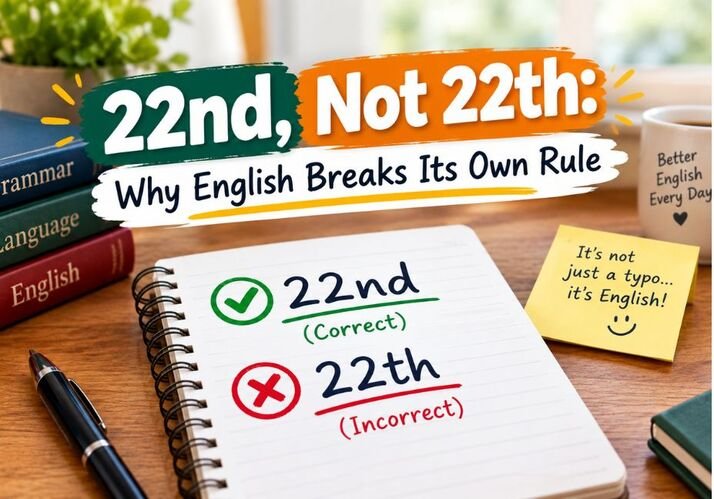
If you’ve ever paused before writing a date, a birthday, or a floor number, wondering whether it’s “22th” or “22nd,” you’re not alone. This mix-up is one of the most common ordinal number mistakes in English, and it trips up native speakers just as often as learners.
This guide breaks down the correct spelling, the grammar rule behind it, why the confusion happens in the first place, and how to use it correctly in dates, birthdays, and formal writing.
Quick Answer: “22nd” is the only correct spelling. “22th” is a common misspelling and isn’t accepted in any form of English. Numbers ending in 2 (except 12) take the “-nd” suffix, which is why 22 becomes 22nd, not 22th.
What Is an Ordinal Number?
Ordinal numbers show position or order in a sequence, rather than quantity. Words like “first,” “second,” and “third” are ordinal numbers, and when written as numerals, they take the forms “1st,” “2nd,” and “3rd.” Most other ordinal numbers simply add “-th” — fourth becomes “4th,” ninth becomes “9th,” and so on.
The number 22 follows the same pattern as 2, because “twenty-two” ends with the word “two.” Since “two” becomes “second,” 22 becomes “22nd” rather than following the more common “-th” pattern.

The Grammar Rule Behind 22nd
English ordinal suffixes depend on the final digit of the number, with a few exceptions. The general rule looks like this:
- Numbers ending in 1 take “-st” (1st, 21st, 31st).
- Numbers ending in 2 take “-nd” (2nd, 22nd, 32nd).
- Numbers ending in 3 take “-rd” (3rd, 23rd, 33rd).
- All other numbers take “-th” (4th, 15th, 20th).
Since 22 ends in the digit 2, it follows the “-nd” pattern, giving you “22nd.” This isn’t a stylistic choice — it’s a fixed grammar rule with no accepted alternative.
Why People Mistakenly Write “22th”
The mistake almost always comes from overapplying the more common “-th” ending. Most ordinal numbers — fourth, fifth, sixth, twentieth — end in “-th,” so it’s natural to assume every number follows that same pattern, including 22.
But the numbers 1, 2, and 3 have kept irregular endings since Old English, becoming “first,” “second,” and “third” instead of adopting “-th.” That irregularity carries over to every number ending in 1, 2, or 3 — including 21, 22, and 23 — which is why “22th” looks logical but isn’t correct.
Is There a British vs American Difference?
No. Unlike spelling differences such as “color” versus “colour,” this is a grammar rule, not a regional variation. Both British and American English use “22nd” exclusively, and “22th” is considered incorrect in every English-speaking country. There’s no formal, informal, or historical context where “22th” is acceptable.
How to Use 22nd in a Sentence
Seeing the correct form in context makes it easier to remember. A few natural examples:
- My appointment is on the 22nd.
- She was born on March 22nd.
- The meeting starts on the 22nd floor.
- Our anniversary falls on the 22nd of June.
Notice that “22nd” works the same way whether it’s referring to a date, a floor, or a general position in a sequence.
Happy 22nd Birthday: Correct Usage
One of the most common places this mistake shows up is on birthday cards and social media posts. The correct greeting is always “Happy 22nd Birthday” never “Happy 22th Birthday.” Because birthday wishes are shared so widely and casually, this is one of the most frequently searched versions of the 22th-or-22nd question.
22nd in Dates and Scheduling
Dates are another high-frequency source of this error, especially in emails, invitations, and calendar entries. Writing “the event is on May 22th” is a noticeable mistake in professional communication, while “the event is on May 22nd” reads as correct and polished. Scheduling documents, contracts, and formal invitations should always use “22nd.”
22nd in Academic and Business Writing
In academic papers, citations, and business documents, spelling accuracy matters more than in casual writing. A misplaced “22th” in a formal report or citation can look like carelessness, even if the rest of the writing is strong. Academic writers should use “22nd” consistently in essays, footnotes, and professional correspondence.
Common Mistakes With Ordinal Numbers
Beyond “22th,” a few related mistakes show up with similar frequency:
- Writing “21th” instead of “21st.”
- Writing “23th” instead of “23rd.”
- Assuming “12nd” or “13rd” are correct (they aren’t — more on this below).
These errors all stem from the same root cause: applying the common “-th” pattern to numbers that follow the irregular “-st, -nd, -rd” rule instead.
Other Numbers That Follow the Same Rule
Once you understand why 22 becomes “22nd,” the same logic applies to a full family of numbers:
- 2nd, 22nd, 32nd, 42nd, 52nd, 62nd, 72nd, 82nd, 92nd.
Every one of these numbers ends in the digit 2 and takes the “-nd” suffix, with zero exceptions within this group.
Numbers That Break the Pattern (11th, 12th, 13th)
There’s one important exception worth knowing: the numbers 11, 12, and 13 always take “-th,” even though they end in 1, 2, and 3. So while “21st,” “22nd,” and “23rd” follow the irregular pattern, “11th,” “12th,” and “13th” do not — they’re “eleventh,” “twelfth,” and “thirteenth,” not “eleventh-first” or similar constructions. This exception also applies to any number ending in 11, 12, or 13, such as 112th or 213th.
How to Remember the Correct Spelling
A simple trick: say the full word instead of just looking at the numeral. “Twenty-second” clearly ends in “second,” which tells you the suffix is “-nd.” If saying the full word ends in “-teenth,” “-th” applies; if it ends in “first,” “second,” or “third,” use “-st,” “-nd,” or “-rd” instead.
Quick Reference Checklist
Before finalizing any date, birthday message, or formal document, run through this quick check:
- Does the number end in 1, 2, or 3? Check if it’s part of the 11–13 exception first.
- If not an exception, use “-st” for 1, “-nd” for 2, “-rd” for 3.
- All other numbers take “-th.”
- When in doubt, “22nd” is always correct — never “22th.”
Frequently Asked Questions
Is “22th” ever correct in any context?
No. “22th” is not accepted in formal or informal English, in any English-speaking country.
Why does 22 take “-nd” instead of “-th”?
Because “twenty-two” ends in “two,” and “two” becomes “second,” giving 22 the “-nd” suffix.
Is this a British vs American English rule?
No. Both varieties of English use “22nd” exclusively, with no regional exceptions.
Are there other numbers similar to 22 that use “-nd”?
Yes — any number ending in 2 (except 12) uses “-nd,” including 32nd, 42nd, and 52nd.
Conclusion
“22nd” is the only correct ordinal form of the number 22, and the rule behind it is simple once you know it: numbers ending in 2 — apart from the 11–13 exception group — take “-nd” instead of the more common “-th.” Whether you’re writing a birthday card, a business email, or an academic paper, remembering that “twenty-two” ends in “second” is the easiest way to get it right every time.