
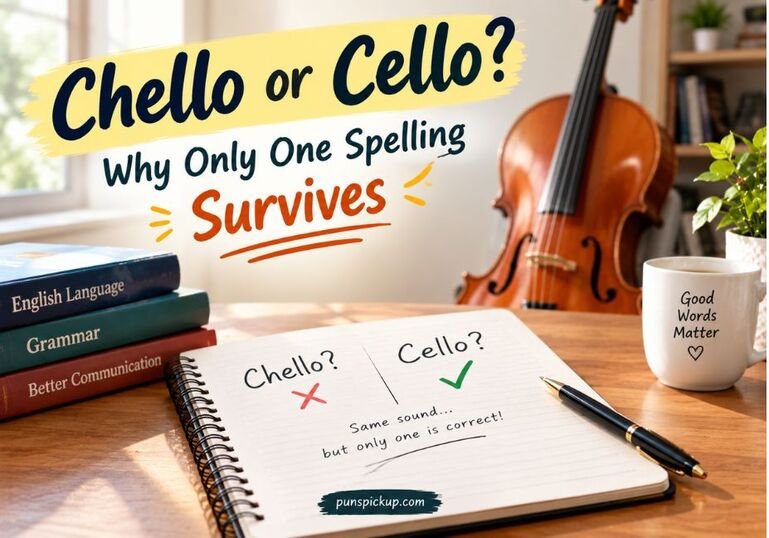
Many people search “chello or cello” because the two spellings look and sound like they could both be right. When you hear the word spoken aloud in a music class or orchestra rehearsal, it’s easy to assume the spelling should include an “h” but only one version is actually correct in standard English.
This guide breaks it down clearly: the correct spelling, where the word comes from, why the pronunciation misleads so many people, and how to use it confidently in writing, school assignments, and professional communication.
Chello or Cello – Quick Answer
The correct spelling is cello. “Chello” is not a recognized English word — it’s a common misspelling caused entirely by pronunciation, not by any real grammatical exception.
- Cello → correct name for the large bowed string instrument.
- Chello → incorrect spelling, sometimes seen as a brand name or typo.
Correct: “She plays the cello in the orchestra.”
Incorrect: “She plays the chello in the orchestra.”
What Is a Cello?
A cello is a large, bowed string instrument belonging to the violin family, known for its deep, warm, and expressive tone. It’s bigger than a violin or viola, played upright while seated, with an endpin resting on the floor to support its weight.
The cello plays a central role in orchestras, chamber music, and classical performances, often serving as a bridge between the higher-pitched violins and violas and the deeper double bass section.
The Origin of Chello or Cello
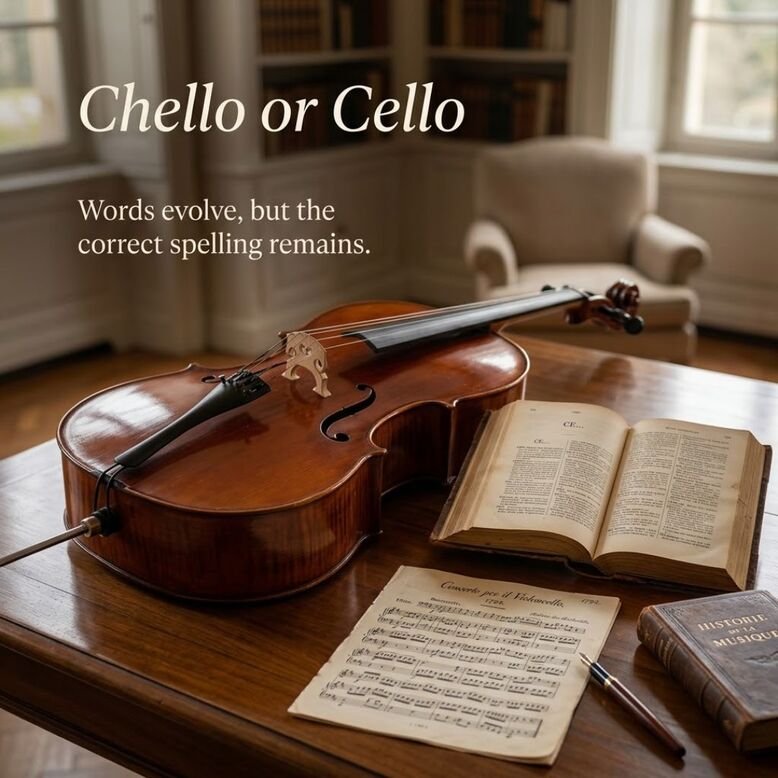
The word “cello” comes from the Italian term violoncello, which roughly translates to “little violone” — the violone being a large, low-pitched ancestor of the modern double bass. The instrument rose to popularity in European classical music during the 17th century and quickly became a staple of orchestras and chamber ensembles.
Musicians eventually shortened “violoncello” to “’cello,” using an apostrophe to represent the missing letters. Over time, the apostrophe was dropped entirely, leaving “cello” as the complete, standalone spelling used today. The spelling “chello” has no historical basis at all — it developed purely from how the word sounds when spoken.
Why the Cello Is Pronounced With a “Ch” Sound
The confusion comes down to one specific rule borrowed from Italian rather than English. In Italian, the letter “c” makes a soft “ch” sound whenever it’s followed by an “e” or an “i.” Since “cello” begins with “ce,” the “c” naturally produces that “ch” sound — no “h” required.
This same rule shows up in other familiar Italian loanwords, including “cappuccino” and “vermicelli,” both of which carry the identical “ch” sound without needing an extra letter to create it. Once you recognize this shared pattern, “cello” stops looking like an exception and starts looking like part of a predictable rule.
Is Chello a Real Word?
Not as a common noun referring to the instrument — “chello” has never appeared as an accepted spelling in any major English dictionary. That said, the spelling does exist elsewhere: Chello was once the name of a European internet service provider, and it occasionally surfaces as a brand name or username. In those specific cases, “Chello” functions as a proper noun, not an alternate spelling of the musical instrument.
British English vs American English Spelling
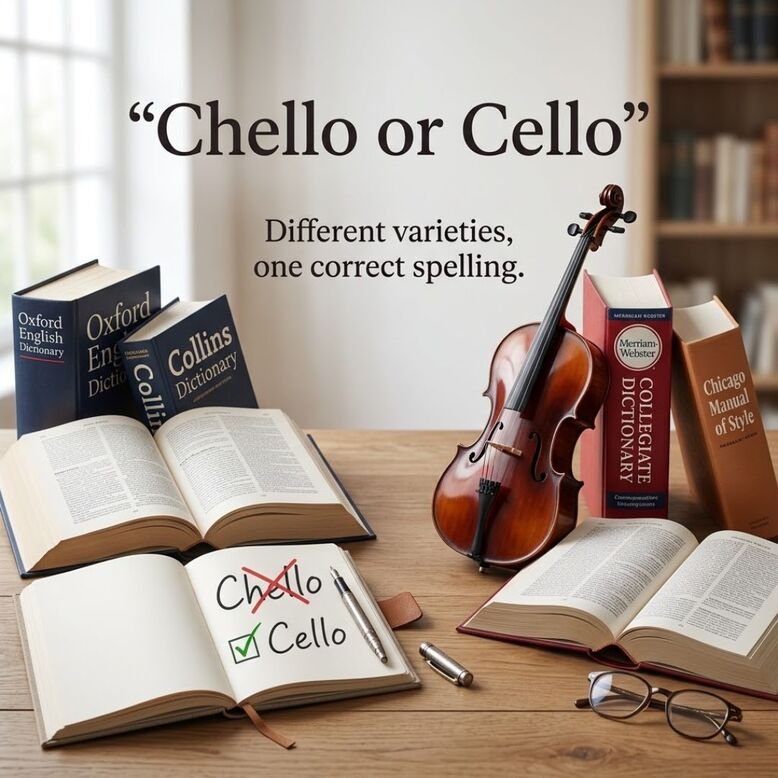
Unlike many English words that vary by region — think “color” versus “colour” — “cello” is spelled identically in both British and American English, along with every other major English-speaking region. There’s no dialect, formal register, or regional context where “chello” is considered correct. If you’ve seen conflicting spelling advice online, it isn’t a regional difference; it’s simply a mistake.
Which Spelling Should You Use?
Always use “cello” when referring to the musical instrument, whether you’re writing:
- Music articles or reviews.
- School assignments or academic essays.
- Emails or professional correspondence.
- Orchestra programs or band discussions.
Avoid “chello” entirely in these contexts, since it isn’t accepted in standard English writing of any kind.
How to Pronounce Cello Correctly
“Cello” is pronounced “CHEL-oh” (/ˈtʃɛloʊ/), with the stress on the first syllable. The “c” produces the “ch” sound discussed earlier, followed by a short “e” and a long “o” at the end. Saying the word aloud actually highlights exactly why the spelling confuses so many people — the pronunciation and spelling simply don’t align the way English speakers typically expect.
Cello in Everyday Examples
Seeing the correct spelling in real contexts reinforces it. A few examples across different settings:
Email: “My daughter started learning the cello this year at school.”
News: “A young musician won a national award for her cello performance.”
Social media: “Just bought my first cello today — excited to start practicing!”
Formal writing: “The cello plays an essential role in classical orchestral music.”
Common Mistakes with Chello or Cello
A few recurring errors show up around this word:
- Writing “chello” out of habit from how the word sounds when spoken.
- Adding an unnecessary apostrophe (“’cello”), a leftover from older, outdated spelling conventions.
- Confusing “cello” with “cellophane” purely due to visual similarity, despite the unrelated meanings.
Remembering that “cello” starts with a plain “c” — not “ch” — solves nearly all of these mistakes at once.
Comparison Table: Chello vs Cello
| Feature | Cello | Chello |
| Correct spelling | Yes | No |
| Found in dictionaries | Yes | No |
| Used in music writing | Yes | No |
| Meaning | String instrument | Misspelling (or brand name) |
Where to Buy or Learn About Cellos
When searching for lessons, sheet music, or a new instrument, always search using the correct spelling. Reputable instrument retailers and music schools list and sell cellos exclusively under the correct name — searching “chello” instead may return irrelevant results or unrelated brands that happen to share the misspelled name.
Chello or Cello – Search Trends & Usage Data
Search interest data consistently shows “cello” far outpacing “chello” in usage and search volume. People typically search “cello” when looking for music lessons, instrument guides, or orchestra information, while searches for “chello” tend to come from quick typing, mishearing the word, or simple uncertainty about the correct spelling. Most of these searches come from music students and beginners just starting to learn about the instrument.
Other Words With the Same Pronunciation Pattern
“Cello” isn’t an isolated case. Several other English words borrowed from Italian follow the same “c before e or i” rule, producing a “ch” sound without needing an “h”:
- Cappuccino — pronounced with “ch,” spelled with “c.”
- Vermicelli — same pattern, no added “h.”
- Cello — follows the identical rule.
Recognizing this shared pattern makes the spelling feel far less arbitrary and much easier to remember going forward.
FAQs
Is chello a real word?
No. Chello is not a correct English word — it’s typically a misspelling of cello.
What is a cello?
A large string instrument played with a bow, known for its deep, rich sound and central role in orchestras.
Why do people write chello?
Because the pronunciation sounds like “ch,” leading many writers to assume the spelling should match.
Do British and American English spell it differently?
No. Both use the identical spelling: cello.
What instrument family does the cello belong to?
The cello belongs to the violin family of string instruments.
Conclusion
The confusion between “chello” and “cello” comes down almost entirely to pronunciation — when spoken aloud, the word sounds like it should start with “ch,” leading many writers to add a letter that was never there. But the correct spelling is simply “cello,” derived from the Italian violoncello, and it stays exactly the same across American English, British English, and every other major variety of the language. Once you recognize that the “ch” sound follows the same Italian rule found in words like “cappuccino,” the spelling stops feeling uncertain — and “cello” becomes the only version you’ll ever need to write.