
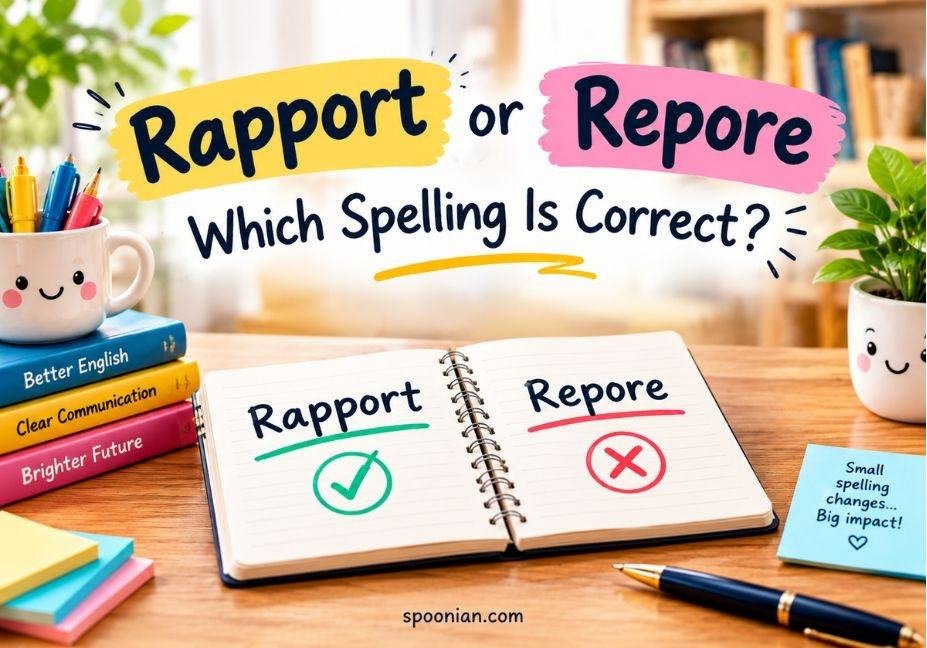
If you have ever typed “repore” into a sentence and paused, wondering if that looks right, you are dealing with one of the most commonly misspelled words in English.
The confusion between rapport or repore comes down to how the word sounds when spoken out loud, since the correct spelling barely resembles its pronunciation. In this guide, you will learn the correct spelling, what the word actually means, and why so many people get it wrong.
We will also cover how to pronounce it properly, where it came from, and how to use it naturally in everyday writing and conversation. By the end, you will never second guess this word again.
Quick Answer: Rapport or Repore?
Rapport is the correct spelling. Repore is a common misspelling based on how the word sounds when spoken. Rapport means a close, friendly relationship built on mutual trust, understanding, and respect between people.
What Does Rapport Mean?
Rapport describes a positive connection between two or more people, one built on trust, comfort, and mutual understanding. According to Merriam-Webster’s definition of rapport, it means a friendly, harmonious relationship, especially one where communication feels easy because both people understand and relate to each other well.
You will often hear the word used in professional settings, like a good rapport between a doctor and patient, a teacher and student, or a salesperson and customer. It also applies to personal relationships, since close friends and couples often talk about the rapport they share.

Why Do People Write It as Repore?
The confusion makes sense once you look at how rapport is actually pronounced. The word comes from French, and the final “t” is silent, which makes it sound like “ra-POR” rather than matching its spelling exactly. Since most English speakers hear the word far more often than they read it, guessing at the spelling based on sound alone often leads to “repore,” “rapore,” or “rapoire.”
This kind of mismatch between sound and spelling is common with borrowed French words in English, since many of them keep their original spelling while losing certain pronounced letters along the way.
Where Does the Word Rapport Come From?
Rapport entered English from French, where it originally meant “to bring back” or “to report.” According to Dictionary.com’s entry on rapport, it was first recorded in English between 1530 and 1540, coming from the French word rapporter, which traces back further to the Latin word portare, meaning “to carry.”
Interestingly, rapport shares this Latin root with the more common English word “report,” which explains why the two words look somewhat alike despite having very different modern meanings. Report focuses on giving information, while rapport focuses on the relationship between people.
How to Pronounce Rapport Correctly
Getting the pronunciation right makes the spelling much easier to remember. Rapport is pronounced “ruh-POR,” with the stress on the second syllable and a completely silent final “t.” Practicing the word out loud a few times, while picturing the silent “t,” helps train your brain to spell it correctly instead of guessing based on sound.
How to Use Rapport in a Sentence
Seeing the word in real examples helps make its meaning and usage clearer.
- The teacher built strong rapport with her students early in the year
- He has always had great rapport with his coworkers
- Good rapport between a doctor and patient improves trust
- She quickly established rapport with the new client
- Their rapport made the interview feel more like a conversation
- A little small talk goes a long way in building rapport
- The coach shares a genuine rapport with the entire team
- Strong rapport often leads to better communication overall
Common Misspellings of Rapport
Because of how the word sounds, several incorrect spellings show up often in casual writing.
- Repore, which drops the double p and adds an extra e
- Rapore, which removes one p from the correct spelling
- Rapoire, which adds an unnecessary i before the final letters
- Reporte, which mixes rapport with the word report
- Repport, which keeps the double p but misplaces the other letters
How to Build Rapport with Someone
Understanding the word is one thing, but building real rapport takes a bit of effort. A few habits tend to help the most.
- Ask genuine questions and actually listen to the answers
- Find common ground through shared interests or experiences
- Match the other person’s tone and energy naturally
- Be consistent so trust has room to grow over time
- Show empathy when someone shares something personal
- Keep body language open and friendly during conversations
- Remember small details people share and bring them up later
- Be patient, since real rapport often builds gradually
Rapport vs Similar Words
Comparing rapport to a few similar looking or sounding words helps avoid future mix ups.

- Report means to give information or an account of something
- Repertoire refers to a range of skills or works someone has mastered
- Connection is a broader word for any kind of bond between people
- Relationship describes an ongoing bond, romantic or otherwise
- Chemistry often refers to a spark or attraction between people
Frequently Asked Questions
Is repore a real word?
No, repore is not a real word and is simply a common misspelling of rapport.
How do you spell rapport correctly?
Rapport is spelled with a double p and a silent final t, pronounced “ruh-POR.”
What does having rapport with someone mean?
It means you share a friendly, trusting connection where communication feels easy and natural.
Is rapport a French word?
Yes, rapport comes from French and traces back further to the Latin word portare, meaning to carry.
Can rapport be used in professional settings?
Yes, rapport is commonly used to describe positive relationships at work, in healthcare, and in education.
Conclusion
Rapport is the correct spelling, while repore is simply a mistake based on how the word sounds out loud. The word itself describes something valuable, a genuine connection built on trust, comfort, and mutual understanding between people.
Once you remember the silent final t and practice the correct pronunciation, spelling it the right way becomes second nature. With this guide, you now have both the correct spelling and a clear grasp of what rapport truly means.