
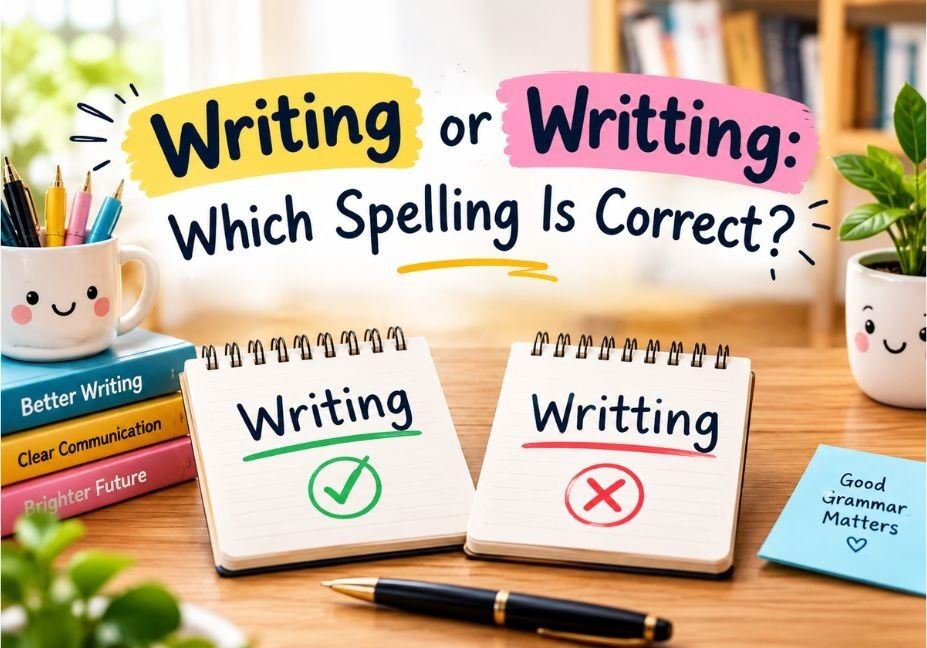
If you have ever paused mid sentence wondering whether it is writing or writting, you are dealing with one of the most common spelling mix ups in English. This confusion usually comes from a basic spelling rule that gets applied to the wrong type of word, since writting looks like it should follow the same pattern as words like running or sitting.
In this guide, you will learn the correct spelling, why the mistake happens so often, and the simple rule that explains it once and for all.
We will also walk through how to use the word correctly in a sentence, where it comes from, and a few related words that follow the same pattern. By the end, you will never have to second guess this spelling again.
Quick Answer: Writing or Writting?
Writing is the correct spelling. Writting is a common misspelling that mistakenly doubles the letter “t.” The word writing means the act of forming words on a surface or creating written content, and it comes from the verb write.
Why Do People Misspell It as Writting?
The mix up happens because of a well known English spelling rule, often called the doubling rule. This rule says that when you add “ing” to a short word ending in one vowel and one consonant, you usually double that final consonant, which is why “run” becomes “running” and “sit” becomes “sitting.” Since write ends in a consonant, it looks like it should follow the same pattern.
The problem is that write does not fit that rule, because it ends in a silent “e.” According to the Wikipedia entry on silent e, this silent letter signals a long vowel sound in the word before it, and when you add a suffix like “ing,” you drop the silent “e” instead of doubling the consonant. That single silent letter is the whole reason writing has one “t” instead of two.
The Simple Rule Behind Writing
Words that end in a silent “e” almost always drop that “e” before adding “ing.” You can see the same pattern in plenty of other common words.
- Write becomes writing, not writting
- Hope becomes hoping, not hopping
- Bake becomes baking, not backing
- Ride becomes riding, not ridding
- Smile becomes smiling, not smilling

Notice how some of these mistakes actually turn into real but different words, like hoping versus hopping, which shows why the rule matters so much for clear communication.
Where Does the Word Writing Come From?
Writing comes from the verb write, which has a long history in English. According to Merriam-Webster’s definition of write, the word traces back to Old English wrītan, which originally meant to scratch, draw, or inscribe, and it has been in use since before the 12th century.
That original meaning makes sense once you think about how early writing worked, since people once carved or scratched letters into surfaces like wood or stone before pen and paper became common. Over time, the word grew to cover everything from handwriting to composing books, letters, and even computer code.
How to Use Writing in a Sentence
Seeing the correct spelling in context helps make it stick.
- She spends most evenings writing in her journal
- Writing clearly is one of the most valuable skills you can build
- He is writing a novel about his childhood
- Good writing takes practice, patience, and plenty of revision
- Their team is writing new content for the website
- Writing by hand still helps some people remember things better
- She improved her writing by reading more often
- Writing under pressure gets easier the more you do it
Words That Follow the Same Pattern
Once you understand the silent e rule, spotting the pattern in other words becomes much easier.
- Drive becomes driving, following the same silent e rule
- Care becomes caring, dropping the e before ing
- Move becomes moving, never movving
- Argue becomes arguing, dropping the final e
- Believe becomes believing, keeping only one v
Common Writing Related Misspellings
Writing is not the only related word people misspell in similar ways.
- Writting instead of writing, the most common mistake
- Writen instead of written, missing the doubled t
- Writers instead of writters, though writters is sometimes mistakenly used
- Rewriting instead of rewritting, following the same silent e rule
- Handwriting instead of handwritting, again dropping the extra t

Frequently Asked Questions
Is writting ever the correct spelling?
No, writting is never correct in standard English and should always be written as writing.
Why does write drop the e before adding ing?
English spelling rules require dropping a silent e before adding a suffix that starts with a vowel, like ing.
Is written spelled with one t or two?
Written is spelled with two t’s, since it follows a different pattern than writing does.
What is the root word of writing?
The root word is write, which comes from the Old English word wrītan, meaning to scratch or inscribe.
Does this rule apply to other words ending in e?
Yes, most words ending in a silent e drop that e before adding ing, such as hope becoming hoping.
Conclusion
Writing is the correct spelling, and writting is simply a mistake that comes from applying the wrong spelling rule to a word that ends in a silent e. Once you understand that write drops its final e before adding ing, the correct spelling becomes much easier to remember. The same rule applies to plenty of other everyday words, so learning it once helps you avoid several common mistakes at the same time. With this guide, you can now spell writing correctly with full confidence every time.