
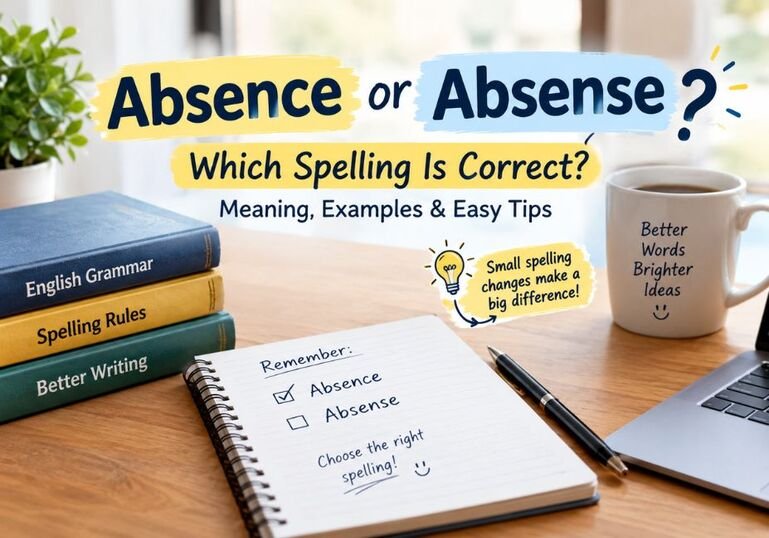
Have you ever typed “absence” and wondered whether it should actually be spelled “absense”? You are not alone. These two spellings look and sound very similar, so it is easy to confuse them.
However, there is only one correct spelling in standard English: absence.
Absense is a common spelling mistake, not an alternative spelling. The word absence is a noun used when someone is not present or when something is missing or does not exist.
In this article, we will explain absence or absense, including the correct spelling, meaning, pronunciation, examples, common mistakes, synonyms, and easy ways to remember the correct form.
Absence or Absense: Which Is Correct?
The correct spelling is absence.
- Absence — correct
- Absense — incorrect
The word is spelled:
A-B-S-E-N-C-E
The most common mistake is replacing the “c” with an “s,” creating absense. Although the pronunciation can make the ending confusing, the written form always contains -ence.
For example:
- His absence was noticed immediately.
- His absense was noticed immediately. (Incorrect)
Whenever you are unsure whether to write absence or absense, choose absence.
What Does Absence Mean?
Absence means the state of not being present. It can describe a person who is away from a place where they are normally expected to be.
For example:
“The teacher noticed John’s absence from class.”
The word can also mean the lack of something.
For example:
“There was an absence of evidence.”
Here, absence does not mean that a person is missing. Instead, it means that evidence was not available or present.
Therefore, absence commonly has two related ideas: being away and something being missing.
What Does Absense Mean?
Absense is not the standard English spelling of the word.
If you write absense, readers will normally understand that you mean absence, but the spelling is considered incorrect.
For example:
“She apologized for her absense.” (Incorrect)
“She apologized for her absence.” (Correct)
If you are writing an email, school assignment, article, application, or professional document, always use absence.
Why Do People Confuse Absence and Absense?
The main reason is pronunciation.
When spoken, absence sounds approximately like “ab-suhns.” The final sound can make people think the word should end with -sense or a similar spelling.
English has many words where pronunciation does not clearly reveal the spelling. As a result, people sometimes write absense because it appears to match the sound.
The important thing to remember is: the sound may be confusing, but the spelling is always absence.
How Do You Spell Absence?
The easiest way to spell it is:
ABS + ENCE = ABSENCE
Pay special attention to the final four letters:
ENCE
Not:
ENSE
You can also remember the word by connecting it with presence.
- presence
- absence
Both words end in -ence.
This is one of the easiest spelling tricks for remembering the correct form.
Absence in a Sentence
Here are some simple examples:
- Her absence was noticed by everyone.
- I missed school because of my absence from home.
- The manager explained his absence from the meeting.
- His long absence worried his family.
- The teacher recorded the student’s absence.
- We noticed an absence of information in the report.
These examples show how absence can describe either a person’s nonattendance or the lack of something.
Absence in School
The word absence is frequently used in schools and educational settings.
If a student does not attend class, the student may be marked absent, and the situation can be described as an absence.
Examples include:
- My absence from school was due to illness.
- The teacher asked about my absence.
- His frequent absences affected his studies.
- Please provide a reason for your absence.
Remember the difference:
Absent describes the person.
Absence describes the state of not being there.
For example:
“Ahmed was absent from class.”
“Ahmed’s absence was recorded by the teacher.”
Absence in the Workplace
Absence is also common in professional and workplace English.
Employees may be absent from work because of holidays, personal matters, emergencies, or other reasons.
Examples:
- Please inform your manager about your absence.
- Her absence from the meeting was unexpected.
- The team managed the project during his absence.
- The company recorded several employee absences.
In formal workplace communication, spelling the word correctly is especially important.
What Is a Leave of Absence?
Leave of absence is one of the most common expressions containing the word absence.
It refers to an approved period when someone takes time away from work, school, or another regular responsibility.
Examples:
- She requested a leave of absence from work.
- He returned after a long leave of absence.
- The employee is currently on leave of absence.
Notice that the correct phrase is always leave of absence, not leave of absense.
What Does “In the Absence of” Mean?
“In the absence of” means when someone or something is not present or available.
It can also mean that something is missing.
Examples:
- In the absence of evidence, the claim could not be confirmed.
- We continued the meeting in the absence of the manager.
- In the absence of clear instructions, we followed the usual procedure.
- The decision was made in the absence of sufficient information.
This phrase is especially common in formal, academic, legal, and professional writing.
Absence vs Absent
Although absence and absent are related, they have different grammatical uses.
Absence is a noun.
“His absence was unexpected.”
Absent is generally an adjective.
“He was absent from school.”
A simple way to remember this is:
Absent = not present.
Absence = the state of not being present.
Both words are correct, but they should be used according to the sentence.
Absence vs Presence
The opposite of absence is usually presence.
- Absence = not being present
- Presence = being present
For example:
“Her absence was noticeable.”
“Her presence made everyone happy.”
There is also a useful spelling connection between the two words. Both end in -ence.
Presence → Absence
This can help you remember that absence needs a c, not an s, before the final e.
Common Misspellings of Absence
Besides absense, people sometimes make other spelling mistakes.
Common incorrect forms include:
- absense
- abscence
- absance
- abcense
The correct spelling is:
absence
The safest approach is to memorize the exact spelling instead of trying to spell the word entirely from its pronunciation.
Is Absense a Word?
In standard English, absense is not the correct spelling of the word meaning “the state of being absent.”
If you encounter absense, it is generally intended to mean absence.
For example:
“The student’s absense was recorded.” (Incorrect)
“The student’s absence was recorded.” (Correct)
Therefore, avoid using absense in formal or informal English.
What Are Synonyms for Absence?
Depending on the context, some words can have a similar meaning to absence.
Common alternatives include:
- lack
- nonattendance
- unavailability
- shortage
- nonappearance
- non-existence
However, these words are not always exact replacements.
For example, nonattendance works well when talking about someone missing school or a meeting, while lack is often more suitable when something is missing.
Common Phrases With Absence
Here are several common expressions you may see in English:
- absence from school
- absence from work
- absence from a meeting
- leave of absence
- in someone’s absence
- in the absence of evidence
- absence of information
- absence of data
- absence of proof
- prolonged absence
- frequent absence
- complete absence
Learning these phrases can make it easier to use absence naturally in your writing.
How to Remember the Correct Spelling
If you repeatedly confuse absence and absense, try these simple tricks.
Remember the “C”
Think:
Absen-C-E
The C is the letter people often leave out or replace with S.
Connect It With Presence
Remember:
presence → absence
Both use -ence.
Break It Into Parts
Write it mentally as:
ABS + ENCE
Then combine the parts:
ABSENCE
These simple methods can help you remember the correct spelling without relying only on pronunciation.
Frequently Asked Questions
Is absence or absense correct?
Absence is correct. Absense is a misspelling.
Is “absense” an English word?
It is not the standard spelling of the word. When people write absense, they generally mean absence.
What does absence mean?
Absence means the state of not being present. It can also mean that something is missing or does not exist.
What is the opposite of absence?
The usual opposite of absence is presence.
Is absence a noun?
Yes. Absence is a noun.
What is the adjective form?
The related adjective is absent.
Example:
“She was absent from work.”
What is the plural of absence?
The plural is absences.
Example:
“The school recorded several absences.”
How do you spell absence correctly?
Spell it:
A-B-S-E-N-C-E
Remember that it ends in -ence, not -ense.