
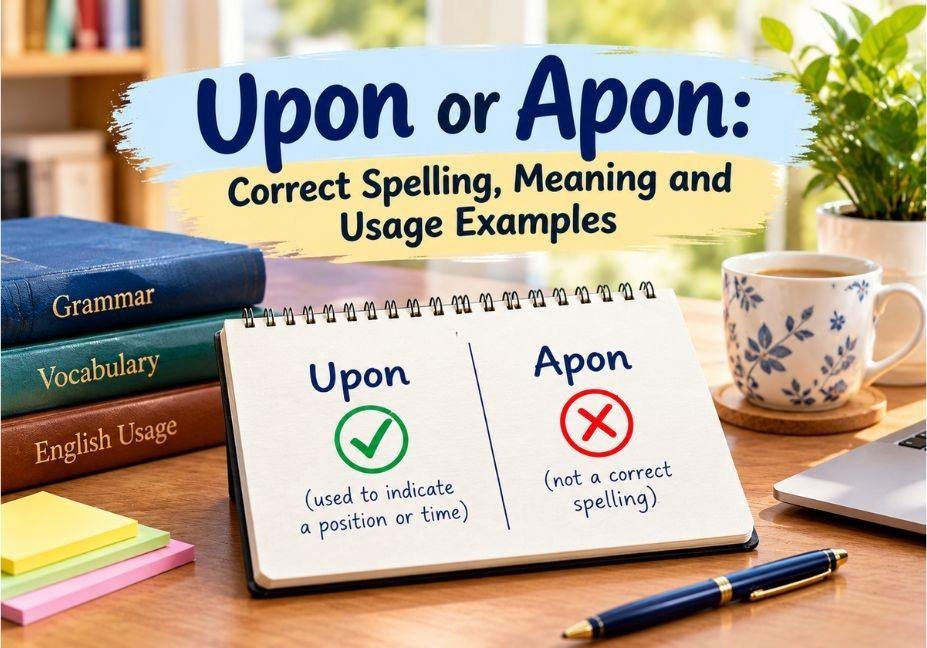
Writers often hesitate over “upon or apon” when they type a sentence in a hurry. The two spellings sound almost the same, but only one is correct. This article explains which one to use and what the word means.
You will also see example sentences and common phrases. A short section shows how upon compares with on.
Quick Answer
Upon is the Upon or apon? It is a preposition that Merriam-Webster defines simply as “on.” Apon is a misspelling. I found no dictionary entry for it.
Upon or Apon: Usage at a Glance
| Context | Meaning | Example | How to tell |
|---|---|---|---|
| Physical position | On top of | The cup sat upon the shelf. (example) | Could swap in “on” |
| Time | Right at a moment | Upon arrival, call me. (example) | Follows an event |
| Fixed phrases | Part of an idiom | The plan was agreed upon. (example) | Verb plus upon |
| Building on ideas | Using as a base | She built upon his work. (example) | Shows a foundation |
| Misspelling | Not standard | Apon | Starts with a |
Upon or Apon: Which Spelling to Use
Always write upon. Merriam-Webster lists it as a preposition with the pronunciation uh-PON. It says the first known use of upon dates to the 12th century.
The spelling apon likely comes from the sound. The first vowel is unstressed and sounds like a soft uh, which can be written with an a. The word itself is built from up and on, which helps you remember the u.
Some pages claim apon is an old or archaic variant. I found no dictionary support for that claim. Treat apon as a spelling error.

What Does Upon Mean?
Upon means on. Merriam-Webster gives that as its main definition. It also lists two adverb senses that are marked obsolete, so you will not need them in modern writing.
In practice, upon appears in a few predictable ways. It can describe position, as in a vase placed upon a table. It can mark a moment in time, as in upon her arrival. It can also appear in set phrases, such as frowned upon.
Example Sentences
These sentences are examples written for this article.
- The book lay upon the desk.
- Upon finishing the report, send it to me.
- She depends upon her team for support.
- The proposal was agreed upon last week.
- We built upon the ideas from the first draft.
In each sentence, the u at the start keeps the word correct. Reading it aloud will not help here, since upon and apon sound alike.
Upon Versus On
Because upon means on, the two words often overlap. Many writers pick on in everyday sentences and save upon for set phrases or a more formal tone. Merriam-Webster’s own examples show upon in lines such as upon her arrival and frowned upon.
Some phrases need upon. Writers say “once upon a time,” and they rarely say “once on a time.” In other places, either word is acceptable. If a sentence sounds natural with on, on is usually the simpler choice.
Upon Versus Up On
Do not mix up the single word upon with the two words up on. The two-word form appears when up works as an adverb and on works as a preposition. For example, a cat can climb up on the roof. Here, up and on do separate jobs.
A quick test helps. If you can remove “up” and the sentence still works, you probably need two words.
FAQs
Is apon a word?
No. I found no dictionary entry for apon. The standard spelling is upon.
Is upon the same as on?
Merriam-Webster defines upon as on. They overlap, but upon often suits set phrases and a more formal tone.
Can I write once apon a time?
No. The correct phrase is once upon a time, with upon spelled with a u.
What is the difference between upon and up on?
Upon is one preposition. Up on is two words, as in climbing up on a roof.
Conclusion
Write upon, not apon. It means on, and it fits fixed phrases such as agreed upon and frowned upon. When in doubt, ask whether on would work, and remember that upon is built from up and on.