
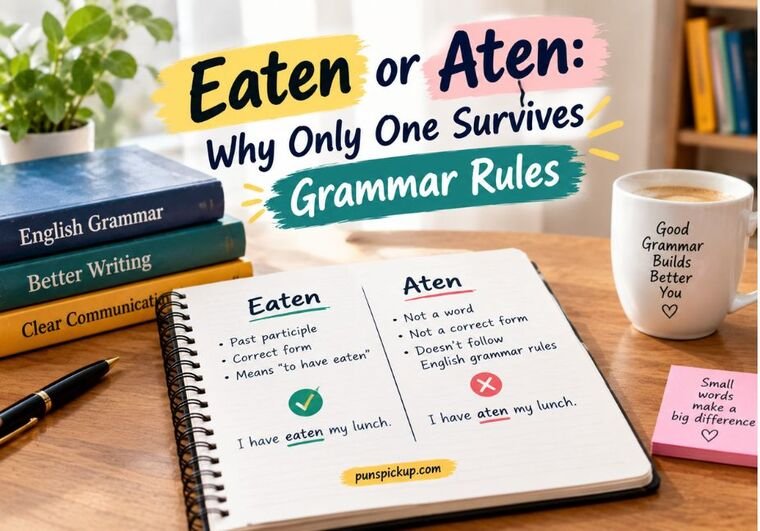
Many people search “eaten or aten” because they’re unsure which spelling is correct — and the confusion almost always starts with how the word sounds rather than any real grammar debate. In fast, everyday speech, “eaten” often gets clipped down until it sounds like “aten,” leaving writers second-guessing themselves the moment they try to type it.
This guide clears up the confusion for good: the correct spelling, the grammar rule behind it, why the pronunciation misleads so many people, and how to use it correctly in writing every time.
Eaten or Aten – Quick Answer
Eaten is correct. Aten is incorrect in standard English.
- Correct: “I have eaten lunch.”
- Incorrect: “I have aten lunch.”
“Eaten” is the past participle of the verb “eat,” and it’s always used together with a helping verb such as “have,” “has,” or “had” — never on its own.
What Do “Eaten” and “Aten” Mean?
“Eaten” means that food (or something else) has already been consumed. It never stands alone in a sentence — it needs a helping verb to function correctly, as in “she has eaten breakfast” or “we had eaten before the meeting.”
“Aten,” on the other hand, has no meaning in standard English grammar. It isn’t a recognized verb form at all — it exists only as a spelling mistake, produced by how the real word sounds when spoken quickly.
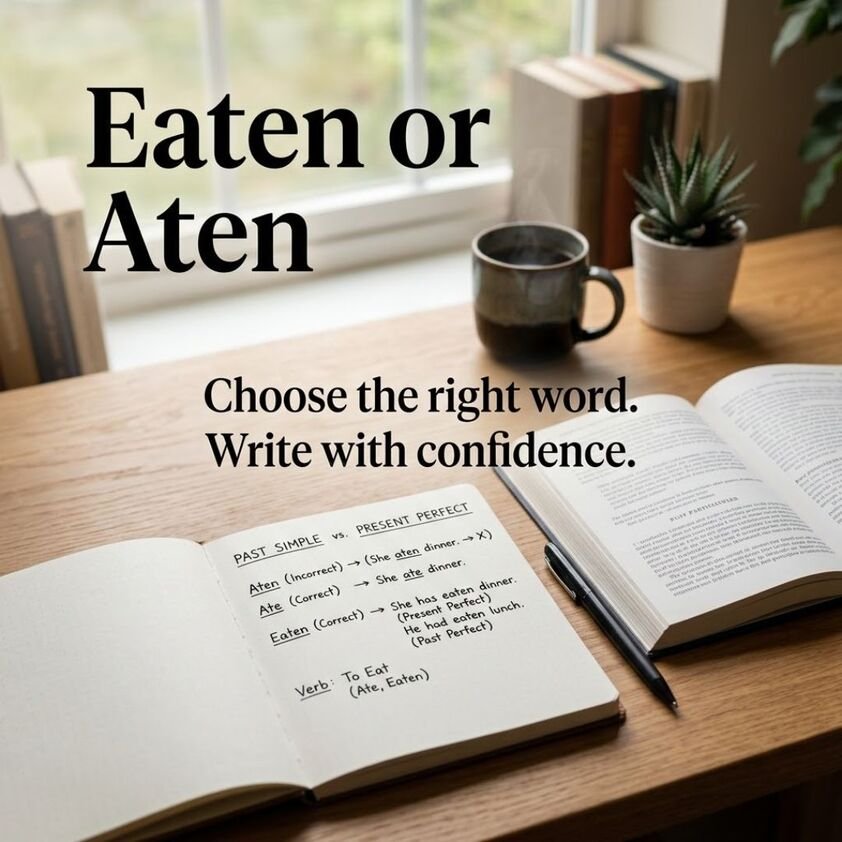
The Verb Forms of “Eat”: Present, Past, Past Participle
Seeing all three forms side by side makes the pattern clear:
- Present: I eat every day.
- Past: I ate yesterday.
- Past participle: I have eaten already.
There is no verb form called “aten” anywhere in this sequence. The verb “eat” is irregular, meaning its forms don’t follow the standard “-ed” pattern used by regular verbs like “walk” (walked) or “play” (played) — but irregular doesn’t mean unpredictable. The three correct forms are fixed and don’t vary.
The Origin of Eaten or Aten
The verb “eat” traces back to the Old English word etan, and like many ancient verbs, it developed an irregular conjugation pattern over centuries of use. The correct forms that emerged were “eat” (present), “ate” (past tense), and “eaten” (past participle) — a pattern that has remained stable in English for a very long time.
The spelling “aten” never existed at any point in this history. It isn’t an older form, a regional variant, or an alternate spelling that fell out of use — it’s simply a modern error caused by pronunciation, with no roots in the word’s actual development.
Why “Eaten” Sounds Like “Aten” in Speech
The confusion comes down to three main factors. First, pronunciation: in fast, casual speech, the initial “e” sound in “eaten” often gets weakened or clipped, making it sound like it starts with “a” instead. Second, irregular verb patterns: English verbs don’t always follow predictable spelling rules, which makes writers more likely to guess incorrectly when a word sounds unfamiliar in writing. Third, a lack of explanation: spellcheck tools often correct “aten” to “eaten” automatically, but they rarely explain why, leaving the underlying confusion unresolved.
Once you understand that “eaten” is simply the fixed past participle of “eat” — with no alternate spelling — the confusion tends to disappear for good.
British English vs American English Spelling
There is no regional difference for this word. Both British and American English use the identical spelling:
- British English: eaten.
- American English: eaten.
Both varieties follow the same grammar rule, using “eaten” with helping verbs in exactly the same way. Unlike genuine spelling differences between the two dialects, this isn’t a case of regional variation — “aten” is simply incorrect everywhere English is written.
Which Spelling Should You Use?
Regardless of your audience, the answer stays the same:
- Writing for a US audience → eaten.
- Writing for a UK audience → eaten.
- Writing for a global audience → eaten.
There is no context — formal or informal, academic or casual — where “aten” is an acceptable substitute.
Ate vs Eaten: What’s the Difference?
Since these two forms are often mixed up together, it helps to see them side by side. “Ate” is the simple past tense, used on its own to describe a completed action: “I ate pizza yesterday.” “Eaten” is the past participle, and it always needs a helping verb: “I have eaten pizza before.”
A common mistake happens when writers blend the two, producing incorrect phrases like “I have ate already” instead of the correct “I have eaten already” or the simpler “I ate earlier.” Keeping the helping-verb rule in mind — “eaten” never appears without one — solves this mix-up instantly.
Common Mistakes with Eaten or Aten
A few recurring errors show up around this word:
- Writing “aten” instead of “eaten” — by far the most common mistake.
- Using “eaten” without a helping verb, as in the incorrect “I eaten lunch” instead of “I have eaten lunch.”
- Mixing up “ate” and “eaten,” producing errors like “I have ate already.”
Each of these traces back to the same root cause: uncertainty about how English irregular verbs are supposed to behave.
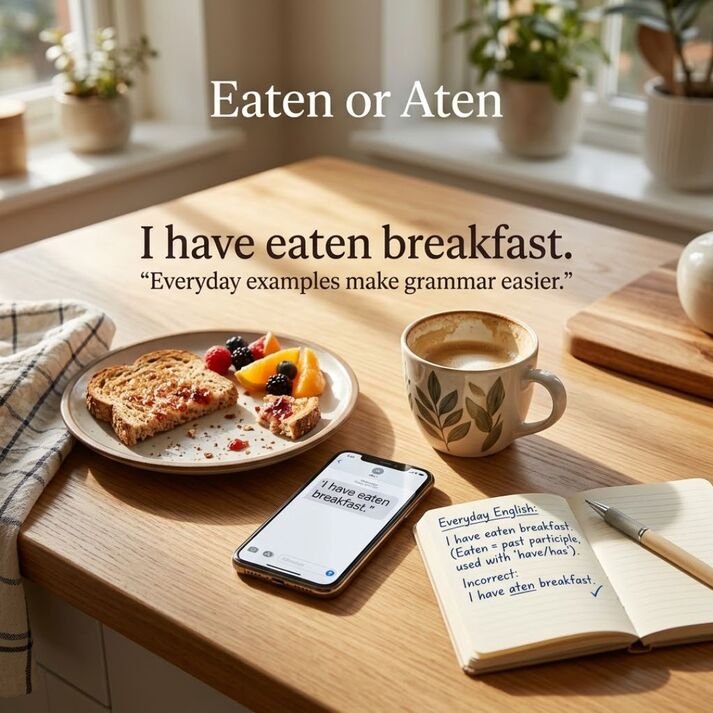
Eaten or Aten in Everyday Examples
Seeing the correct spelling used naturally across different contexts reinforces it:
Email: “I have already eaten, thank you.”
News: “Most of the crops have been eaten by pests.”
Social media: “Just eaten the best burger ever!”
Formal writing: “The samples have been eaten by animals.”
Is “Aten” Ever a Real Word?
Not as a verb — but “Aten” does exist as a proper noun in a few unrelated contexts. In ancient Egyptian religion, Aten refers to the sun disc, an aspect of the sun god Ra. It also appears as a surname, an asteroid name, and even the name of a technology company. In every one of these cases, “Aten” functions as a capitalized proper noun, entirely separate from the verb form of “eat” — it’s never a substitute for “eaten” in ordinary sentences.
Other Irregular Verbs That Cause Similar Confusion
“Eat” isn’t the only irregular verb that trips people up. A few others follow the same pattern of causing spelling uncertainty due to their past participle forms:
- Write → wrote → written (not “writed” or “writen”).
- Speak → spoke → spoken (not “speaked”).
- Break → broke → broken (not “breaked” or “broked”).
Recognizing that “eaten” belongs to this same family of irregular past participles makes the correct spelling easier to remember going forward.
Eaten or Aten – Search Trends and User Intent
People typically search “eaten or aten” because they want quick confirmation of the correct spelling, not because the meaning itself is unclear. This search is especially common among students, non-native English speakers, casual writers, and content creators looking to double-check their grammar before publishing. Since these searches appear worldwide, this is clearly a spelling clarity issue rather than a meaning problem — and grammar guides and dictionaries consistently confirm that “eaten” is the only correct form.
Comparison Table: Eaten vs Aten
| Word | Correct | Reason |
|---|---|---|
| Eaten | Yes | Correct past participle of “eat” |
| Aten | No | Not a valid English spelling (except as a proper noun) |
FAQs About Eaten or Aten
Is “aten” ever correct as a verb form?
No. It is not recognized in standard English grammar under any circumstances.
Why does “eaten” sound like “aten”?
Fast, casual speech often weakens or clips the initial “e” sound, making it sound like “a.”
Is “eaten” spelled differently in British vs American English?
No. Both use the identical spelling: eaten.
What is the simple past tense of “eat”?
“Ate” — used without a helping verb, unlike “eaten.”
Can “Aten” ever be correct as a proper noun?
Yes, as a name (such as the ancient Egyptian sun disc or a surname), but never as a verb form.
Conclusion
The confusion between “eaten” and “aten” comes down almost entirely to pronunciation, not any real ambiguity in English grammar. “Eaten” is the fixed past participle of “eat,” always paired with a helping verb, and it stays exactly the same across British English, American English, and every other major variety of the language. Once you remember that “aten” has no verb-form meaning at all — aside from its unrelated life as a proper noun — the spelling stops feeling uncertain, and “eaten” becomes the only version you’ll ever need to write.