
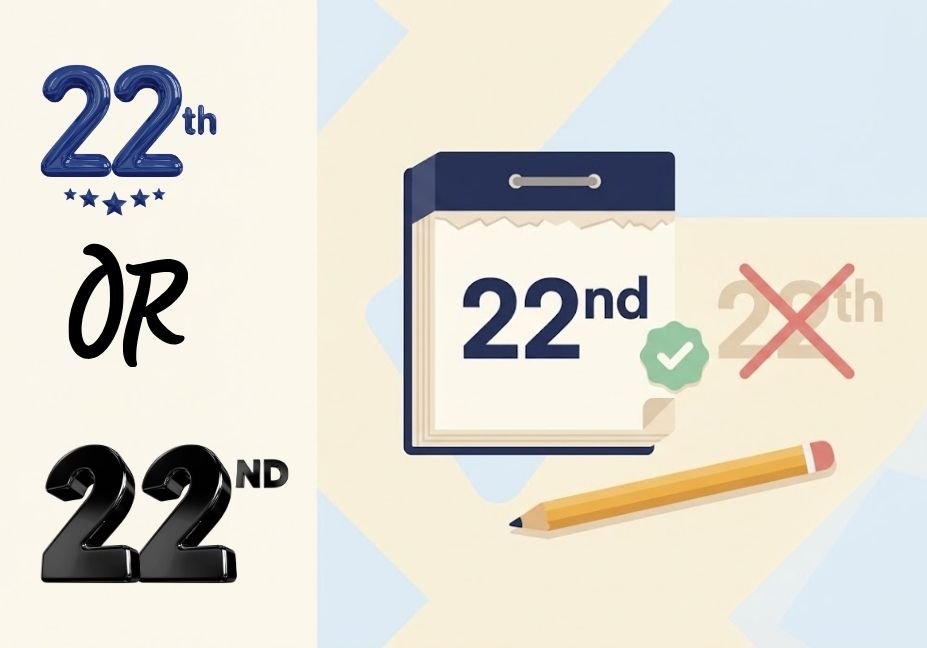
You are writing a date, a birthday card or a race result, and you stop. Is it 22th or 22nd? Many numbers end in “th,” so “22th” can look right at first glance.
This guide gives you a clear answer. You will learn which form is correct, why it works that way and how to pick the right ending for any number. It also shows when style guides drop the ending completely.
Answer: 22nd Is Correct
22nd is the correct ordinal form of 22. “22th” is a spelling mistake in standard English. The number ends in 2, and the word “second” ends in “nd.” So twenty-two becomes 22nd.
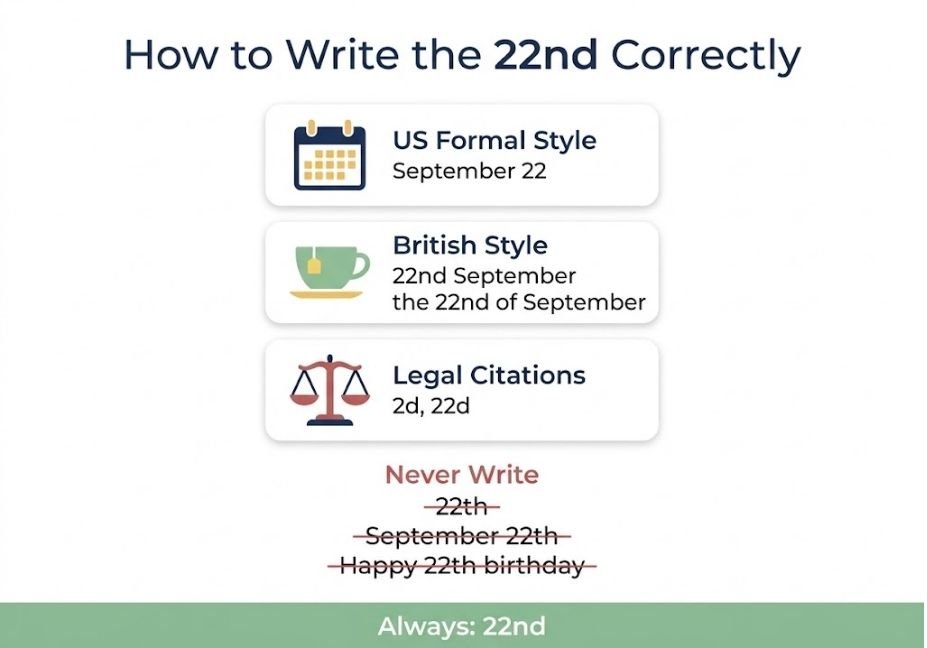
22nd at a Glance: Where You Will Use It
| Context | Correct form | Example (illustrative) | Quick check |
|---|---|---|---|
| Birthdays | 22nd | Happy 22nd birthday! | Say “twenty-second” aloud |
| Rankings | 22nd | She finished 22nd. | Ends in 2, not 12 |
| Dates (British style) | 22nd | 22nd September | Day comes first |
| Dates (US style guides) | 22 | September 22 | Suffix is usually dropped |
| Words | twenty-second | the twenty-second floor | Hyphen joins the words |
| Legal citations | 2d, 22d | 2d Cir. | Bluebook citations use “d” |
Why “22th” Is Wrong
Most ordinal numbers end in “th.” Think of 4th, 9th, 17th and 100th. Because this ending is so common, many writers add it to every number by habit.
The pattern changes for numbers that end in 1, 2 or 3. Their endings copy the last letters of the spoken word. Because we say “first,” we write “st.” The word “second” gives us “nd,” and “third” gives us “rd.”
We say 22 as “twenty-second.” Nobody says “twenty-twoth.” That gives you an easy test: if the written ending does not match the spoken word, it is wrong.
The Ordinal Suffix Rule in Two Steps
You can find the right ending for any whole number with two quick checks. Start with the last two digits, then look at the final digit.
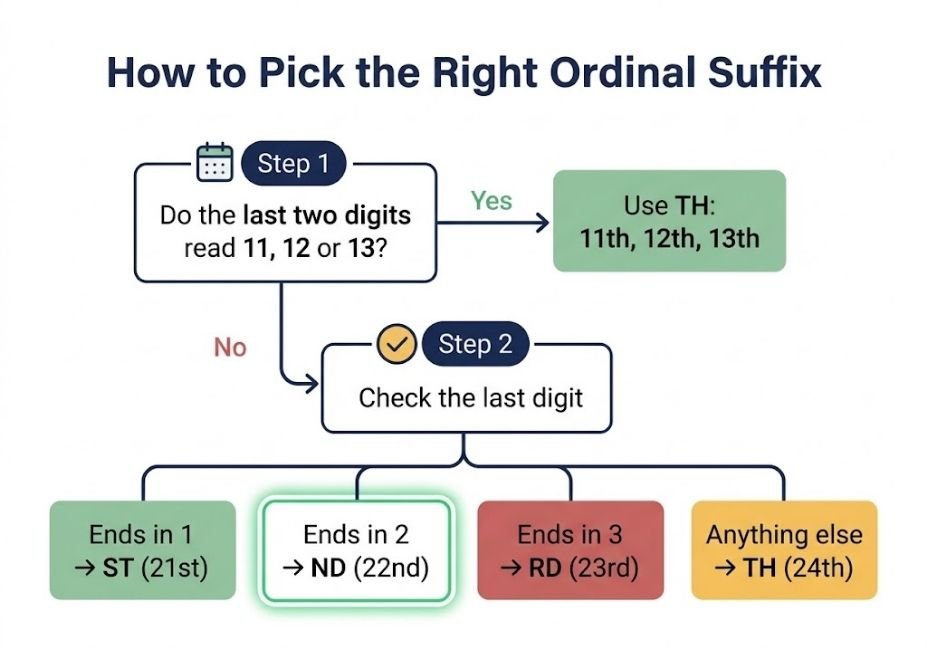
Step 1: Check the Last Two Digits
Do the last two digits read 11, 12 or 13? If so, use “th.” This gives you 11th, 12th, 13th, 111th, 212th and 313th.
Step 2: Check the Last Digit
If Step 1 does not apply, look only at the final digit:
- Ends in 1: use “st” (21st, 31st, 101st)
- Ends in 2: use “nd” (22nd, 42nd, 122nd)
- Ends in 3: use “rd” (23rd, 53rd, 1,003rd)
- Ends in 0 or 4 to 9: use “th” (20th, 24th, 99th)
Now test 22. Its last two digits are 22, not 12, so Step 1 does not apply. The final digit is 2, so the answer is 22nd.
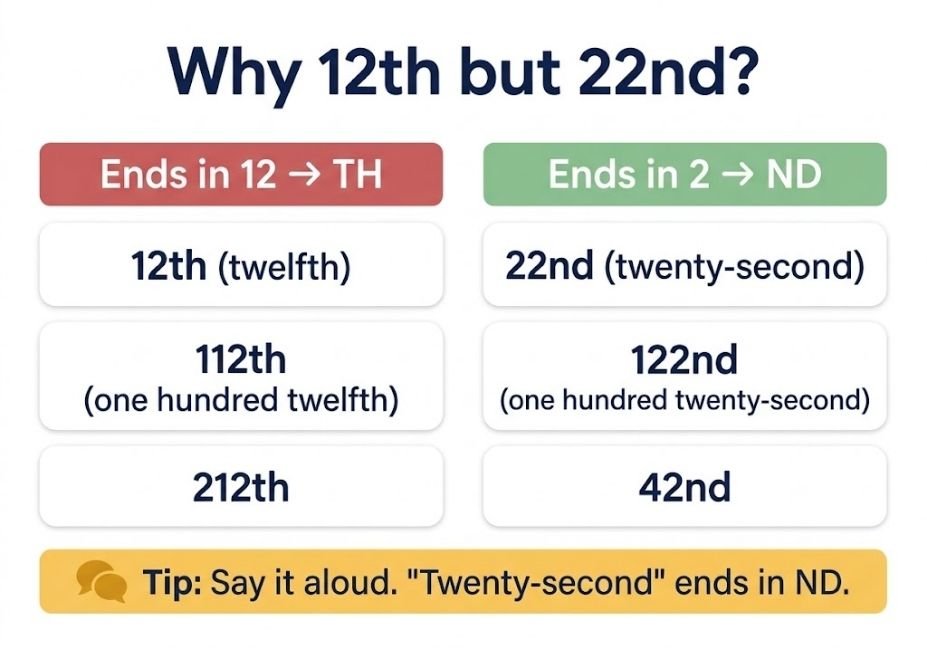
Why 12th Uses “th” but 22nd Uses “nd”
Some quick guides say numbers ending in 2 “always” take “nd.” That is not quite true, and it leads to mistakes like “12nd.”
We say 12 as “twelfth,” not “twelve second.” The word ends in “th,” so the written form is 12th. Larger numbers that end in 11, 12 or 13 follow the same exception, such as 111th, 212th and 313th.
Twenty-two works differently. It joins “twenty” and “two,” and only the last part turns into an ordinal. That makes it “twenty-second,” which gives you 22nd.
Here is a side by side comparison:
- 12 becomes 12th (twelfth)
- 22 becomes 22nd (twenty-second)
- 112 becomes 112th (one hundred twelfth)
- 122 becomes 122nd (one hundred twenty-second)
Similar Mistakes to Watch For
Once you know the rule, related errors are easy to catch. Each of these breaks the same pattern as “22th”:
- 21th should be 21st
- 22st or 22rd should be 22nd
- 23th should be 23rd
- 12nd should be 12th
- 13rd should be 13th
A quick fix for all of them is to say the number aloud. The ending you hear is almost always the ending you should write.
Using 22nd in Dates and Birthdays
Dates and birthdays are where the 22th or 22nd question comes up most. The rules are simple once you know your audience.
Formal US Dates
In American writing, major style guides prefer plain numbers for dates. The Chicago Manual of Style writes the day of the month as a cardinal number, so it prefers “April 18” over “April 18th.” The Associated Press Stylebook takes the same view. The CDC’s clear writing guidance agrees that dates do not need ordinal letters, even though you pronounce them.
So in formal US writing, “September 22” is the safest choice. You still read it aloud as “September twenty-second.”
22nd September or September 22?
Both are correct. The order depends on where your readers live.
British writers usually put the day first, as in “22nd September,” “22 September” or “the 22nd of September.” American writers put the month first, as in “September 22.” In casual writing, “September 22nd” is fine too.
Whatever order you choose, the suffix never changes. “22th September” and “September 22th” are always wrong.
Happy 22nd Birthday
The correct greeting is “Happy 22nd birthday!” On a card or in a speech, you can also spell it out as “Happy twenty-second birthday.”
Avoid “Happy 22th birthday,” even in a quick text. The exception only matters for a younger friend: their greeting is “Happy 12th birthday,” not “12nd.”
Should “nd” Be Raised Like a Superscript?
Word processors often turn “22nd” into a small raised “nd” by default. This is a design choice, not a grammar rule.
Many style guides prefer the suffix at normal size. The Chicago Manual of Style says ordinal letters should not appear as superscripts. Normal size text is also easier to read on phones and screens.
To stop the automatic change in Microsoft Word, go to File, then Options, then Proofing. Open AutoCorrect options and uncheck “Ordinals (1st) with superscript.”
Special Case: 22d in Legal Writing
You may see “2d” or “22d” in court papers and law reviews. This is not a typo. It follows a specific citation style.
The Bluebook is the main US legal citation guide. Inside citations, it uses a shorter form for ordinals that end in 2 or 3. A Georgetown Law guide to common Bluebook errors reminds writers to use 2d and 3d in citations and to skip superscripts. That is why you see forms like “F.2d” and “2d Cir.”
Outside legal citations, stick with 22nd. Even in legal documents, normal sentences use the regular “nd” and “rd” forms.
Writing Twenty-Second in Words
Sometimes you will spell the number out. The correct form is twenty-second, with a hyphen between the two words.
This hyphen rule covers every ordinal from twenty-first to ninety-ninth. Examples include thirty-second, forty-third and ninety-first.
Capitalize it only at the start of a sentence or in a title. For example: “Twenty-second place went to the home team.”
FAQs
Is 22th ever correct?
No. “22th” is not a standard form in American or British English. The correct ordinal is always 22nd, or “twenty-second” in words.
How do you pronounce 22nd?
Say it as “twenty-second.” The written “nd” comes straight from the end of the word “second.”
Why is it 112th and not 112nd?
Numbers ending in 12 follow the word “twelfth,” which ends in “th.” So 112 becomes 112th, while 122 becomes 122nd.
Should I write September 22 or September 22nd?
Formal US writing usually uses “September 22.” Casual writing can use “September 22nd.” British writers often prefer “22nd September.”
Is 22d the same as 22nd?
Yes, both mean the same thing. The “22d” form appears mainly in Bluebook legal citations. Use 22nd everywhere else.
The Takeaway on 22th or 22nd
The answer to 22th or 22nd is simple: 22nd is correct. First check whether the number ends in 11, 12 or 13. If it does not, let the last digit choose the ending.
When in doubt, say the number aloud. “Twenty-second” ends in “nd,” so the written form does too. For formal US dates, you can skip the suffix and write “September 22.”